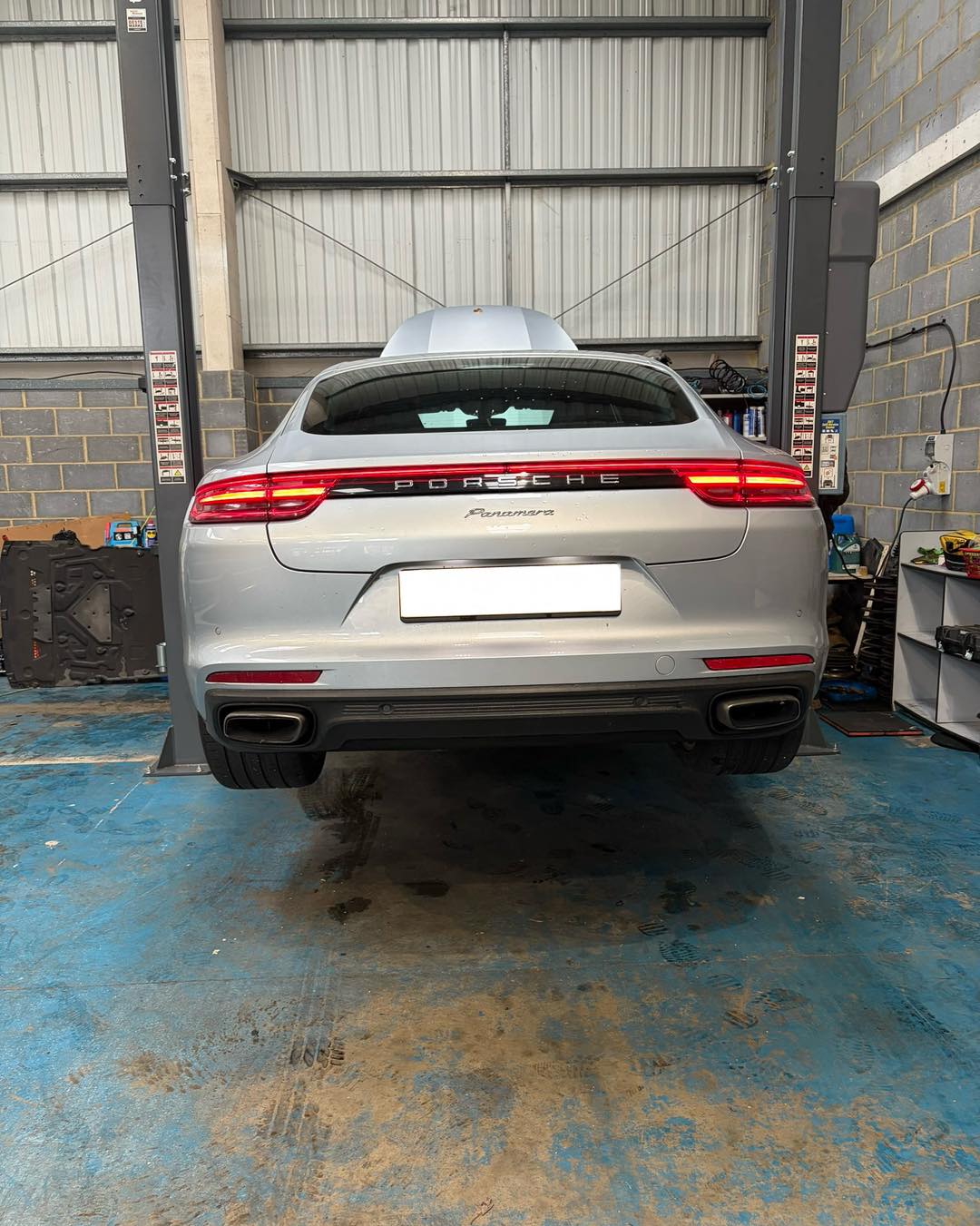
Pre-Purchase Inspection at our own workshop on London Road, a few minutes from Hackbridge station. Most cars around here do short local journeys, which changes what needs doing — so we service to how the car is used rather than to a generic list.
The typical Hackbridge car does short journeys. The station is a few minutes away and takes
about 25 minutes off you to Victoria, the shops on the London Road parade are walkable, and the
rest is a run to Sutton or Wallington and back. Very little of that gets an engine properly warm.
Short-hop driving changes what wears. Oil stays contaminated for longer because it never gets
hot enough to drive off the moisture and fuel that collect in it, which is why a car doing 4,000
short miles a year can need its oil changed on time rather than on mileage. Batteries never fully
recover their charge. Brake discs surface-rust between uses and get scored by it. Exhausts corrode
from the inside out.
None of that is a reason to service more often for the sake of it. It is a reason to service
on the right schedule for how the car is actually used, which for a lot of cars around here is
the time interval rather than the mileage one. We will tell you which applies to yours rather
than defaulting to whichever is further away.
It also means the inspection matters more than the oil. On a low-mileage local car the things
that fail are the things that rot and seize rather than the things that wear out, and those are
found by looking.
What we find on low-mileage local cars
Oil that is past it on time rather than mileage. Short journeys leave fuel
and moisture in it, and no amount of low mileage fixes that.
Brake discs corroded at the edges. A car that sits for days between four-
minute runs surface-rusts and never wears it back off.
Seized rear calipers and handbrake mechanisms. The classic low-mileage
failure and a common MOT advisory around here.
Tyres aged out rather than worn out. Plenty of tread, sidewalls cracking.
Age matters as much as depth.
Coolant and brake fluid never changed. Both degrade on time, not on
distance, and both get forgotten on a car that barely moves.
Which is why the inspection matters more than the oil change on a car like this. What fails
locally is what rots and seizes, and the only way to find those is to look.
Mechanical
Pre-Purchase Inspection: what’s involved
Buying a used car privately or from a small trader means trusting a description written by the person taking your money. An inspection replaces that with evidence: measurements, gauge readings, diagnostic data and a technician's judgement, gathered in a couple of hours on a ramp. The point is not to find a perfect car, because used cars are not perfect. The point is to know what you are actually buying and what it is likely to ask of you in the first year.
Most of the cost in used-car ownership sits in a short list of items: timing components, clutches and dual mass flywheels, turbochargers, diesel particulate filters, automatic gearbox condition, corrosion in structural areas, and repaired accident damage that was never done properly. Those are the things an inspection concentrates on, alongside the everyday consumables that decide whether the car sails through its next MOT or arrives at it with a bill attached.
From £149Written quote first
2–3 hoursTypical time in the workshop
3 monthsWorkmanship warranty
When an inspection is worth the money
A private sale with no comeback
Buying privately means the car is sold as seen and consumer protection is thin. An hour on a ramp is cheap compared with discovering a corroded sill afterwards.
Service history that looks thin
Stamps that stop three years ago, or an invoice folder with nothing for a cambelt on an engine that is well past its interval, change what the car is worth.
Mileage that does not match condition
A worn pedal rubber, a polished gear knob and a slack driver's seat on a low-recorded car are worth looking at properly.
A car that has been repaired
Paint that does not match under a light, uneven panel gaps or fresh underseal in one area all deserve measuring before you commit.
An expensive or complex model
Turbo diesels, twin-clutch gearboxes, air suspension and self-levelling systems all carry repair bills that dwarf the cost of checking them first.
You are buying at distance
If you cannot get to the car easily, or you are buying on a deposit before travelling, an independent set of eyes is the only sensible protection.
A dealer who will not let you road test properly
Any reluctance to let the car be driven cold, or inspected by a third party, tells you something before we even start.
You simply want a second opinion
Plenty of people book an inspection on a car they already like, purely to check there is nothing they have missed.
When should it be booked?
Book once you have seen the car, decided you want it and agreed with the seller that it can be inspected. Most people hold the car with a refundable deposit and a clear condition that the sale depends on the report. The car needs to come to our Hackbridge workshop, because a proper look requires a ramp, and we ask that it arrives cold so we can hear the first start of the day. Local collection can sometimes be arranged if the seller agrees in writing.
After the viewing, before any money changes hands
With the seller's written agreement that the car can be inspected
Ideally arriving cold, not after a long drive
Alongside a separate provenance check for finance, theft and write-off records
Before the end of any distance-selling return window if you have already bought
What we inspect
Identity and paperworkWe compare the VIN on the chassis and the plate with the V5C, check the registration against the free gov.uk MOT history, and read the mileage pattern across past tests for anything that does not follow.
Cold start and idleThe first start tells you about rattles from timing chains, tappet noise, a smoky diesel and a weak battery. We listen before the engine warms and hides things.
Body and paint surveyPanel gaps, shut lines and fixings are checked, and a paint depth gauge is run over each panel. Readings far above factory thickness show filler or a respray, and we record where.
On the rampUnderneath we look at sills, jacking points, floor pans, subframe mountings and suspension turrets for corrosion or distortion, and check for oil, coolant, gearbox and power steering leaks.
Running gear measurementBrake pad thickness and disc lipping are measured, tread depth is taken on all wheels including the spare, and tyre date codes and brands are recorded. Joints and bushes are levered for play.
Full diagnostic scanEvery module is scanned for stored and pending codes, and we check whether the emissions readiness monitors have completed. Monitors that are not ready suggest the codes were cleared very recently.
Fluids and service itemsOil condition and level, coolant strength, brake fluid moisture content and the state of the air and pollen filters give a fair picture of how the car has been looked after.
Road testWe drive the car to assess clutch bite and flywheel rattle, gear selection, kickdown, brake judder, steering feel, noise from bearings and whether it holds a straight line.
Report and conversationYou get a written report grouping findings into faults now, attention soon and points to note, with photographs of anything significant. We then talk it through so you can decide what to do.
What we use, and what we can quote
An inspection fits nothing, so it needs no parts. We use measuring equipment rather than opinion: a paint depth gauge, a brake pad gauge and tread depth gauge, a refractometer or tester for coolant and brake fluid, and dealer-level diagnostic equipment for the module scan. If you buy the car, we can price any work the report identifies and carry it out here with a written quote first.
Paint depth gauge readings recorded panel by panel
Measured brake pad, disc and tyre tread figures
Coolant strength and brake fluid moisture testing
Multi-module diagnostic scan with fault and readiness data
Written report with photographs of significant findings
Optional written quote for any repairs identified
How long it takes
2–3 hours
A thorough inspection takes two to three hours including the road test and writing up. Larger vehicles, and cars where something found early needs chasing further, take longer. We normally report the same day, by phone first if you are under time pressure from the seller.
What’s included
VIN and documentation cross-check against MOT history
Ramp inspection of structure, corrosion, leaks and running gear
Paint depth survey for previous repair work
Diagnostic scan of all available modules
Road test by an experienced technician
Written report you keep, explained to you directly
Finding us
We are on London Road, which is the point
There is no journey to describe. We are at Unit 1 Soho Mills on London Road, which is the road
you are already on — a couple of minutes from the station, the parade and the level
crossing, and inside the SM6 postcode rather than a drive away from it.
That changes how you can use us, and it is worth saying plainly:
You can walk in. If something is making a noise, bring it down and we will
look at it rather than booking you in for a week on Thursday to hear a description of it.
You can leave the car and walk home. Most of Hackbridge is ten minutes on
foot from the yard, which removes the whole business of arranging a lift or waiting in a
reception.
You can get to the station from us. If the car has to stay in, you are a few
minutes from the platform rather than stranded.
We can look at it before quoting. Where a job needs the car on a ramp to
price honestly, being local means that is a short detour rather than a second trip across
town.
Being the workshop in the place rather than the workshop near it is most of why people use us.
It is also why we would rather tell you something is not worth repairing than take the work —
we are going to see you in the Co-op.
Pre-Purchase Inspection in Hackbridge: your questions answered
My mileage is tiny. Do I still need a service?
Usually yes, on time rather than on mileage. Short local journeys contaminate oil faster than long ones and are harder on brakes and batteries, so a low-mileage Hackbridge car often needs the time interval rather than the distance one.
Will servicing here affect my warranty?
No. Servicing to the manufacturer’s schedule with the right parts and a proper record keeps a warranty intact. That is the legal position and has been for years.
Can I wait while it is done?
For shorter jobs, yes. For a full service most local customers leave the car and walk home, which is ten minutes from most of Hackbridge.
Where exactly are you in Hackbridge?
Unit 1 Soho Mills, London Road, SM6 7HN — a couple of minutes from Hackbridge station and the parade. There is room to leave a car with us.
Can I just turn up?
For a look at something, yes. For work that needs a ramp and a slot, call or put your registration into the box on this page first so we can give you a time rather than keep you waiting.
Instant quote
Price your pre-purchase inspection now
Enter your reg and we’ll look up your car and price the job from our own labour rates and the book time for your model. Then book it in with a fixed written quote before any work starts.
Free, about 30 seconds, no sign-up
Parts, labour and VAT included
3-month workmanship warranty
Collection from Hackbridge can be arranged
“It’s rare to find a garage you can truly trust. Fair price, brilliant customer service.”Thinushan K. · ★★★★★ Google